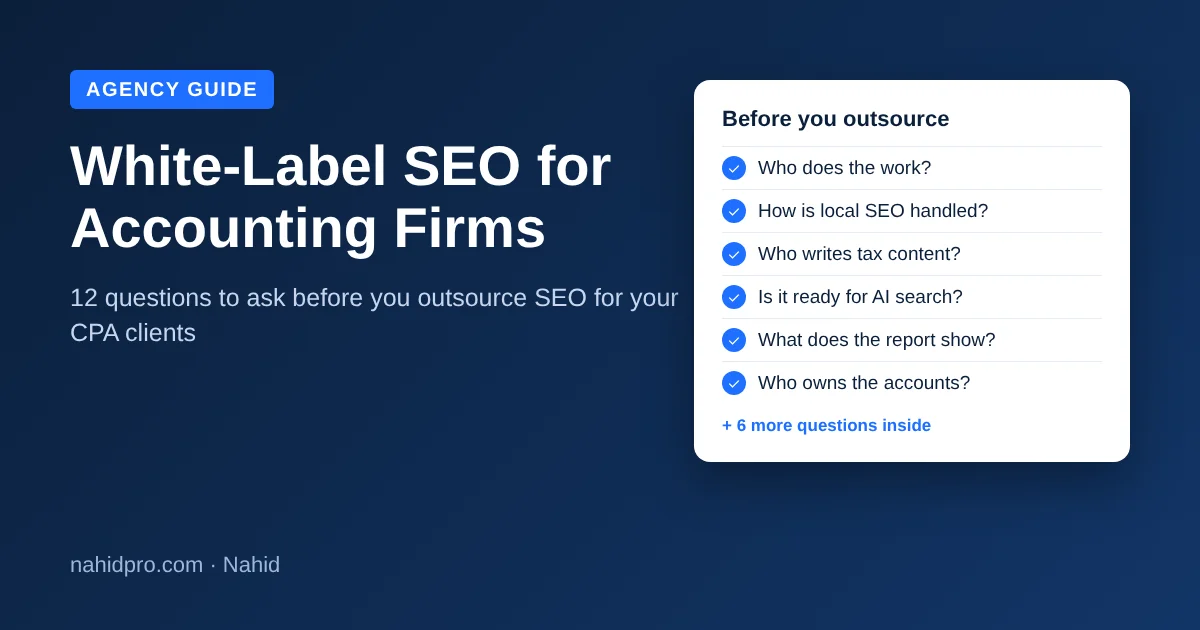
Before a marketer or agency outsources website and SEO work for accounting firm clients, it should ask a white-label partner 12 questions: who does the work, how local SEO is handled, how content is written for tax and finance topics, what is reported each month, how AI search is covered, and what happens to the work if the partnership ends. Clear answers protect your margin and your client relationships. Vague answers usually mean problems three months later.
Many marketers who serve accounting firms are excellent at copywriting, content, campaigns and lead generation. Then a client asks for a new website, or wants to know why the firm does not show up on Google. That is technical work: building the site, page speed, local SEO, schema and ongoing maintenance. Most solo founders and small agencies do not want to do it themselves, and they should not have to.
White-label web and SEO solves that. A technical specialist does the work behind the scenes and you deliver it under your own brand, while you keep the client, the strategy and the copy. The model works well, but only if you pick the right partner. This guide covers what to ask, what good answers sound like, and the red flags to watch for.
What is white-label SEO for accounting firms?
White-label SEO means an outside specialist plans and delivers SEO work, and your agency presents it to the client as your own. The client never sees the partner. For accounting firms, that work usually includes local SEO, technical fixes, service page optimization and content about tax, bookkeeping, payroll and advisory services.
Accounting is a niche where generic SEO often falls short. Firms compete in small local markets, their services change with tax deadlines, and the content has to be accurate because prospects are trusting them with money and sensitive data. A partner who understands this saves you a lot of review time.
Why marketers outsource the technical work for CPA clients
- More to offer: you can say yes when a client asks for a website or SEO, instead of sending them elsewhere.
- Margin: you price the work yourself without paying a full-time developer.
- Capacity: you can take on more accounting clients without hiring.
- Focus: you keep doing what you do best: copy, campaigns, leads and client relationships.
- Consistency: monthly work keeps moving even when your team is busy with launches.
12 questions to ask before you outsource
1. Who actually does the work?
Ask whether the person you talk to is the person doing the work, or whether tasks are passed to junior staff or other subcontractors. You want to know exactly who touches your client’s website and Google Business Profile.
2. Have you worked with accounting or CPA firms before?
Ask for examples. A partner with accounting experience already knows the core service pages, the seasonal search patterns around tax deadlines and the trust signals prospects look for, such as credentials, reviews and team bios.
3. How do you handle local SEO?
Most CPA firms win clients within a few miles of the office, so local SEO matters more than national rankings. A good answer covers the Google Business Profile, consistent name, address and phone details across directories, location pages, and a steady flow of real reviews. Google’s own Business Profile guidelines are a useful benchmark for what the partner should follow.
4. What does your technical SEO audit include?
Ask what they check on day one. You should hear about site speed and Core Web Vitals, mobile usability, indexing and crawl errors, redirects, duplicate pages, schema markup and secure HTTPS. Ask to see a sample audit.
5. Will you work with my copy, or rewrite it?
If you write the copy, the partner should build around it, not replace it. Ask how they handle your page copy and blog posts: formatting, headings, internal links, meta titles and schema should be added without changing your message. If they also publish content for you, ask how tax and finance accuracy is checked before anything goes live.
6. How do you prepare sites for AI search?
More prospects now ask tools like ChatGPT, Gemini and Google’s AI Overviews questions such as “do I need a CPA for my small business taxes”. A partner should talk about clear question-and-answer content, FAQ sections, structured data, and consistent business details across the web so AI tools can trust and cite the firm.
7. What will the monthly report show?
Ask for a sample report. It should show work completed, keyword and map pack movement, organic traffic, and most importantly enquiries: calls, form fills and booked consultations. Confirm the report can carry your own logo and no mention of the partner.
8. Can the work stay fully under our brand?
Ask whether the partner will ever contact your client directly, whether they use your email domain or a neutral one, and whether they will sign an NDA. The answers should be simple: no direct contact, your brand only, and yes to the NDA.
9. How do you price the work?
Every accounting firm is different. A single-office tax practice needs very different work from a multi-location firm with advisory and payroll services. A good partner prices around the scope rather than forcing every client into the same package, and leaves enough room for your agency margin.
10. How fast do you reply, and in which time zone?
Ask about response times on business days and how urgent issues are handled. An offshore partner can be an advantage: work often happens overnight and is ready when your team starts the day.
11. Who owns the work and the accounts?
The client or your agency should own the website, Google Business Profile, Search Console and Analytics accounts. The partner should be added as a user, never as the owner. This protects everyone if the partnership ends.
12. What happens if we stop working together?
Ask how handover works: access removed, documents and keyword research shared, and no content taken down. A partner who is confident in their work has no reason to make leaving difficult.
Red flags to watch for
- Guaranteed number one rankings or a fixed timeline for page one.
- Reports that show only rankings and never mention leads.
- Bulk link building from unrelated or low-quality sites.
- Requests to own your client’s Google Business Profile or domain.
- No examples of work for professional service firms.
- Slow replies before you have even signed anything.
A simple way to test a partner
Before you commit a full client, start with one small, clear task: an audit of a single accounting firm website, or a rebuild of one outdated site. You will see the quality of the work, how the partner communicates and how well they follow your process. If you want a structured starting point, use the free CPA Firm Website Audit checklist to compare what the partner finds against your own review.
Frequently asked questions
What is the difference between white-label SEO and an SEO reseller?
The terms are often used the same way. Both mean an agency sells SEO under its own brand while a partner does the work. Some people use “reseller” for packaged plans and “white-label” for custom work delivered quietly under the agency’s name.
How long does SEO take to work for an accounting firm?
Local improvements, such as better Google Business Profile visibility, can show within a few weeks. Organic rankings for competitive service terms usually take three to six months of steady work, depending on the market and the state of the website.
Is local SEO more important than national SEO for CPA firms?
For most firms, yes. The majority of new clients come from the surrounding area, so the Google map pack, location pages and reviews usually bring more enquiries than national rankings.
Can a white-label partner also handle the website?
Yes, and it often helps. When the same person builds and optimizes the site, speed, structure and schema are set up correctly from the start instead of being fixed later.
Looking for a white-label SEO partner for your accounting clients?
I am the technical partner for marketers and agencies who serve accounting firms. You handle the copy, campaigns and leads. I handle accounting firm websites, white-label SEO and website care, delivered fully under your brand. Pricing is affordable and built around each project, and every client gets lifetime free support. You can read more about how the partnership works, or see the case studies.
Have a client with an outdated site? I will rebuild it at no cost so you can judge the quality first.
